When I was a teenager, my mother took up painting. Wednesday evenings, she attended watercolor classes at my high school, through our town’s adult education program. She set up an easel in the spare bedroom. At first, she painted whatever the teacher had them do for class. Later, she branched out and liberated her talent. Her favorite subjects were flowers and lighthouses.
My stepdad died when I was 30, and my mom’s desire to go anywhere died with him. She retreated into her aloneness, choosing to go out only when she absolutely needed to. I encouraged her to resume her watercolor classes. But she didn’t absolutely need to take a painting class. Nor did she absolutely need to visit me, thousands of miles away. On my annual visits to her, we sat around the wooden table in the kitchen, or on mesh folding chairs in the back yard. I’d nag her to get out more. In response, she’d grow angry. Nagging and anger often seemed to be our only shared activities.
My nagging never resulted in Mom taking more watercolor classes, but she still painted. My husband and I continued to receive her art as gifts. Our walls were filled with her still lifes and landscapes, flowers and lakes, lighthouses and boats. Muted blues and greens and pinks and grays.
On my own after a divorce, I lived as I wanted. I began collecting art that spoke to me as an independent, single woman in her forties. A collage of San Francisco Victorians, reds and purples and oranges. A huge batik, orange giraffes eating green trees. An oversized canvas with stenciled coral birds soaring over painted mountains. A piece of wall art made from vibrant bottle caps. This pivot to bold, new art crowded out my mom’s gentle watercolors.
My mother’s life was nearly over when it finally occurred to me that her withdrawal from the world decades before had been her pivot. Her version of my art collection. On her own for the first time, no parents, no kids, no husband, she lived as she wanted. In solitude.
By the time Mom died, I was almost 60. Just one of her paintings—three blue irises with softly curving green leaves—still hung on my wall. The rest were in a closet, with all the other things that didn’t fit in my little house. My mother, never visiting me, never knew.
When I went through her big house after she died, I found unused pads of textured white paper, jars of paintbrushes, ancient tubes of paint. Stacks of paintings, unframed and unsigned. She had always signed the watercolors she gave away, in one or another of the bottom corners. These, she hadn’t thought good enough to give anyone. Many were painted back and front, as if they were only practice, and she just hadn’t gotten around to throwing them out. Mom never believed in her own talent. They were all quite good.
Remembering the watercolors in my storage closet, I hesitated to keep any of this newfound stash for myself. Even so, two called to me. A mountain lake with pink flowers clustered in the foreground. A lone sailboat near a pier, cloudy sunrise in the background. I put them aside, gifted others to relatives and friends.
The day we celebrated my mom’s life, the sky was a vivid blue and the sun warmed her back yard. I set up a table outside, filled it with snacks and drinks, plates and cups and napkins. Even though Mom had barely left her house in decades, there were still people who loved her, people who would come pay their respects. Relatives and friends from before. Neighbors who chatted over the fence. Folks who helped maintain her house and yard. I made room on the buffet table for a stack of her paintings, the ones that still needed homes. I encouraged the guests to take any they liked. By the end of the afternoon, none remained.
After the celebration was over, after I got back to my house on the opposite coast, I pulled out Mom’s old watercolors from my closet. There were 11. The two I’d just brought home made 13. While I still had my mother, I didn’t think twice about hiding her paintings away. Now that she was gone, her things had taken on significance. It no longer seemed possible to keep her creations in the closet. Should I take down the art I’d acquired and replace it with my mom’s watercolors? Or crowd everything together on the walls? Or could I figure something else out?
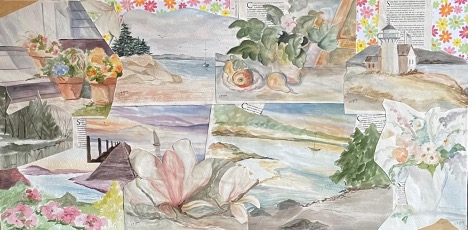
Some of the non-Mom art pieces I’d collected were collages, one beautiful thing layered on another. I didn’t inherit the artist gene, but I could study what I liked about the collages that hung in my house. I could buy a massive canvas—24 by 48—and some Mod Podge. Some wrapping paper with multicolored daisies. I could pry my mom’s watercolors out of their frames. I could tear pages from a book written in Italian, the language of our ancestors.
As I pulled on my mother’s faded Mount Holyoke sweatshirt and spread the materials over my dining table, it dawned on me that she and I were finally doing something together. Something other than nagging, other than anger. It took longer than I would have guessed – the cutting, the arranging, the imagining her with paintbrush in hand, the rearranging, the listening to her voice inside my head, the rearranging again, the gluing, the sealing. The better part of a week to create a collage that now covers my bedroom wall, where I wake to it each morning and say, “Look, Mom, look what we made together.”